Data centers today are in high demand, many even have contracts in place for facilities that aren’t yet operational. From this demand, you might assume that every data center is “bursting at the seams” in terms of space and power. But the reality is there is a gap between the “high demand” and the actual utilization of existing facilities. In this gap, between the “high demand” and the actual, there is a large opportunity to increase revenue and compute.
Colocation operators can close this gap, with real-time monitoring, digital twin simulation, and power-aware orchestration, and serve more AI workloads, generate more revenue per megawatt, and maintain the reliability their tenants demand.
Proactively Analyzing Your Facility to Maximize Revenue
Oftentimes colocation operators are focused on maximizing reliability by not changing anything. The risk of change doesn’t seem to justify the potential upside. While there may be a sense of safety in this, the reality is that there is only missed revenue in this approach. While reliability and risk must be actively managed, there are intelligent ways to do so while also exploring optimization and revenue potential.
In order to safely explore options for improved operations or expanded client footprints, it is helpful to both have real time data visible and also have the ability to examine “what-if” scenarios. For example:
- “What if circuit A increased load to 500 kW?”
- “What if we relocated half of the workloads on these racks to another room?”
- “What if we reduced the setpoint on CRAC 124, CRAC 125?”
This type of examination is only possible through an intelligent digital twin that enables operators to build trust in their system. After trust is built, the capability to change the physical reality is unlocked. Software that continuously models the facility's thermal, electrical, and IT state doesn't just reduce risk, it reframes risk entirely, turning "don't touch anything" from a survival strategy into a missed opportunity.
This isn't about taking blind risks; it’s about building a digital twin that earns your trust. When you have a software layer that actually understands the physics of your thermal and electrical state, you stop guessing. You move from a reactive posture, where every change is a threat, to a proactive one, where you finally have the data to sell the "headroom" you’ve been sitting on for years.
The Colocation Tech Stack to Maximize Compute
Pulling this off requires a unified software layer that synchronizes facility constraints with compute demand. PADO’s AI-powered energy orchestration platform provides the intelligence needed to convert every available watt into predictable compute.
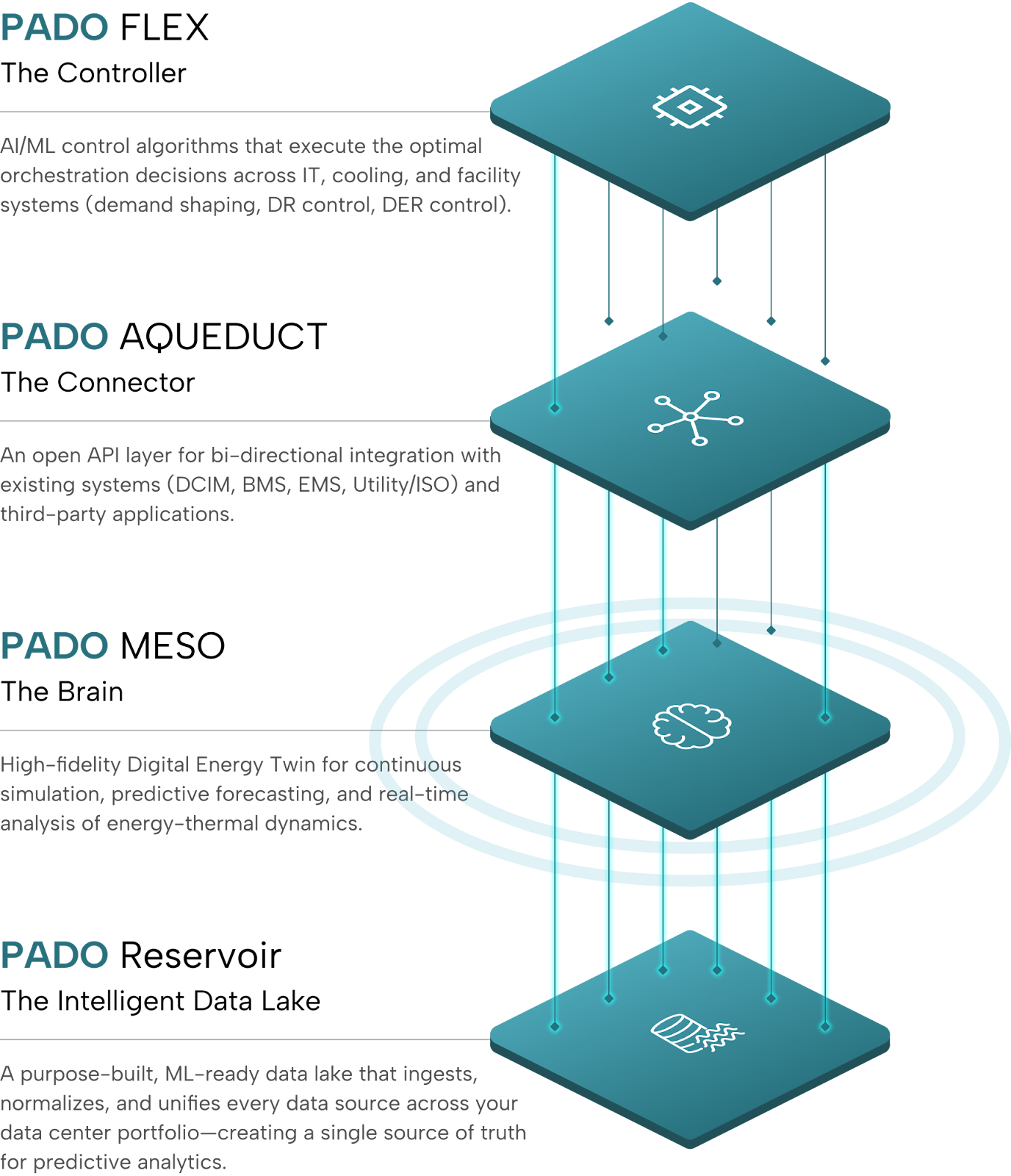
- Real-time Visibility through PADO Reservoir: You can't dynamically manage what you can't see. PADO Reservoir is the ML-ready data lake that unifies disparate data across the ecosystem (BMS, DCIM, EPMS, etc) into a single source of truth. We often see 10+ systems in data centers, all of them claiming to be a single pane of glass, with no true single source of truth.
- PADO Meso provides a high-fidelity "Digital Twin" for informed simulation and forecasting. Operators can model complex variables (e.g. workload profiles, energy markets, and system constraints) to evaluate the impact on power and cooling before anything hits production.
- PADO Flex to realize the optimizations identified by PADO Meso. This is the intelligent orchestration that makes a tiered, flexible model enforceable. PADO Flex connects the intelligence to the equipment and systems within the facility. Meso may identify a large amount of power and compute could be freed up by relocating workloads, PADO Flex is what actually allows the operator to take action in real time and move the workloads accordingly.
- PADO Aqueduct enables all of the intelligence to be realized across the ecosystem. Set point changes are sent to the BMS, battery discharge instructions sent to the BESS, and updating UPS settings in the EPMS.
The PADO tech stack is designed for speed by enabling quick integration for all sources of data and allows operators to start to experiment with the digital twin and gain comfort with optimization. The Flex and Aqueduct layers are designed as additional layers that can be deployed when operators are comfortable with initial analysis and optimization suggestions.
Keeping Pace in a Tight Colocation Market
Colocation operators face extremely tough competition from hyperscalers on one hand and competing retail colocation providers on the other. It’s tough to compete with the hyperscaler's ability to absorb pricing pressure through sheer volume and on the other hand it’s tough to grow awareness versus the bigger name brand colocation providers. A large advantage however is the ability to move faster, customize deeper, and build closer relationships with tenants than a hyperscaler ever will. But agility without intelligence is just busyness. The providers who will thrive in the AI era are the ones who recognize that intelligent systems aren't a capital expense to defer - they're the mechanism by which a 10MW facility competes with a 100MW one. When your facility data is unified across power, cooling, and IT systems, your digital twin is running continuous simulations, and your orchestration layer is dynamically managing headroom in real time, you stop competing on price per kilowatt and start competing on outcomes per kilowatt.
From Static Infrastructure to Dynamic Digital Capacity
The gap between a data center operating at 40% utilization and one operating at 80% utilization isn’t a better sales team but better intelligence. The tools to close the gap exist today: real-time visibility, safe “what-if” simulations, and intelligent orchestration. The operators who move now will own the relationships, the density, and the margin that define the next decade of colocation. The ones who wait may not be around in another decade.
Ready to find the capacity you didn't know you had? PADO's orchestration platform helps colocation operators unlock hidden capacity, safely explore optimization, and compete for the AI workloads that are reshaping the market. Talk to our team to see what your facility is leaving on the table.
